
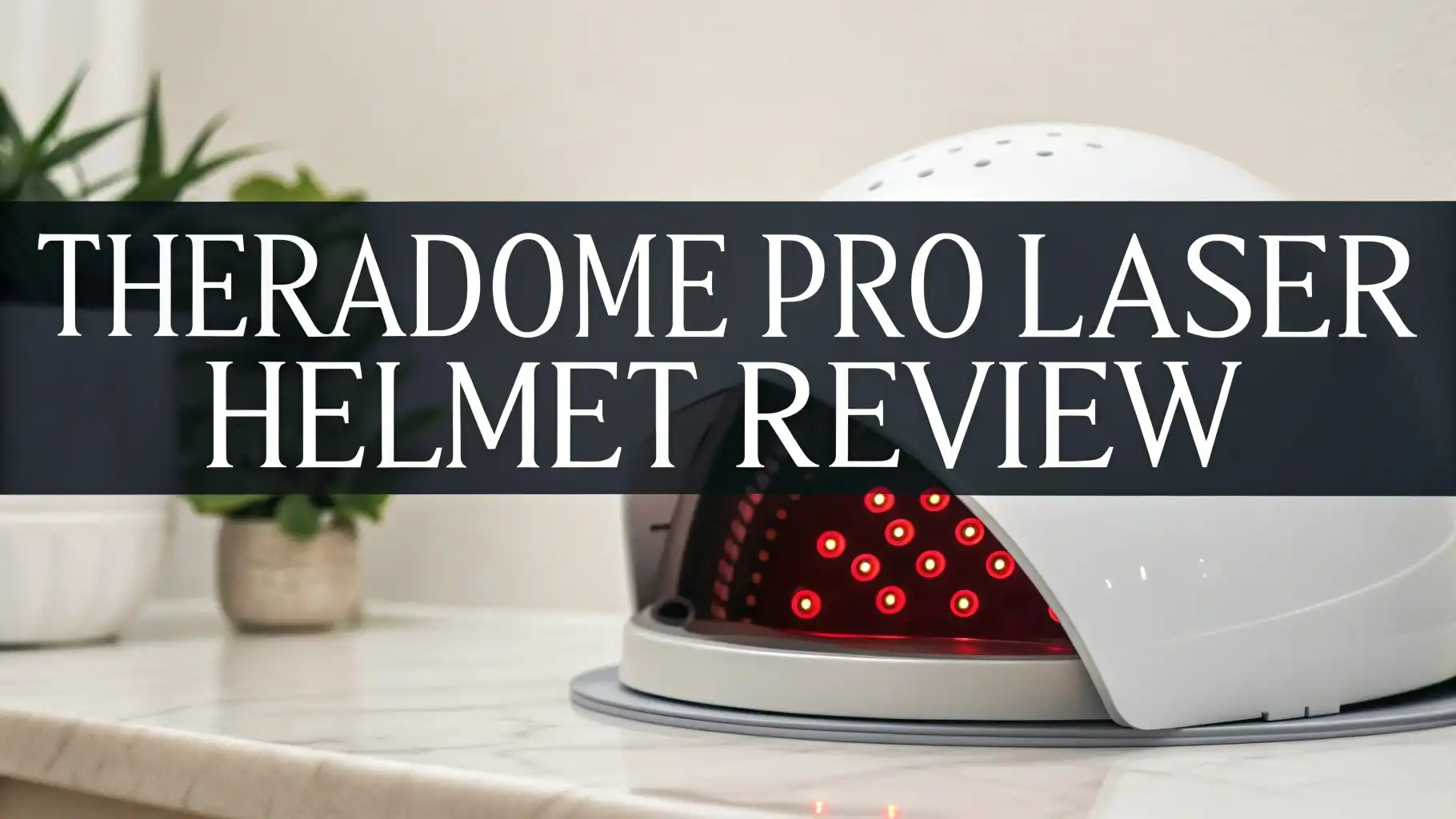
Theradome Pro Laser Helmet Review 2026: Complete Guide
Hair loss is stubborn. It creeps in slowly and then one day the mirror tells a different story. You start buying shampoos that promise thick hair. You read about minoxidil. You wonder if a laser helmet is worth a thousand dollars.
The Theradome Pro sits at the top of that last question. It is a Food and Drug Administration cleared red light helmet. It costs $995 on Amazon. It promises fewer shedding hairs in 30 days and visible regrowth in six months.
That is a big promise for a device you wear for 20 minutes twice a week.
I spent months reading owner complaints, company data, competitor specs, and clinical research. I wanted to know one thing. Does this helmet earn its price in 2026, or is a cheaper laser cap a smarter buy?
In a Nutshell
It is a pure laser device, not an LED gadget. Most helmets mix weak LEDs with a few lasers and call the total a diode count. The Theradome Pro uses 80 medical grade laser diodes at 680nm and zero LEDs. That wavelength sits well inside the 650nm to 680nm range studied for hair growth. You get real delivered energy, not a light show.
You treat twice a week for 20 minutes. The device pushes 6 J/cm² in a single session and about 727 Joules in total. Most rivals ask for daily sessions of 12 to 30 minutes. If your schedule is tight, that difference matters a lot over a year.
It is fully FDA cleared and made in the USA. The original clearance dates to 2013, with male pattern hair loss added in 2018. The lasers are built in California. That matters for quality control and for people who avoid imported electronics.
The warranty is shorter than you might expect. You get a 6 month guarantee, extendable to 12 months after completing a short quiz. Competitors often give 6 to 7 months as standard. A 5 year extended plan costs extra.
The price is $995 at Amazon, not the sticker $1,428.99. It is cheaper than iRestore Elite and far cheaper than Capillus Pro. It is more expensive than Kiierr and iRestore Professional.
Fit is the most common complaint. Owners with larger heads or thick hair report a helmet that shifts and foam pads that feel tight. Try the return window before you commit.
What Is the Theradome Pro Laser Helmet

- Advanced Laser Technology for Hair Wellness: The Theradome Laser Hair Therapy Helmet uses medical-grade laser...
- Powerful & Targeted Light Therapy: Unlike other devices that mix lasers with LEDs, Theradome utilizes 40-80 premium...
- Full Scalp Coverage for Convenient Treatment: Theradome’s ergonomic helmet design ensures hands-free, full-scalp...
Last update on 2026-10-22 / Affiliate links / Images from Amazon Product Advertising API
The Theradome Pro model code is LH80. The name is simple. Eighty laser diodes sit inside a helmet shell that covers your whole scalp. The number 80 is the reason for the code.
A laser scientist named Tamim Hamid built the first version. His background included work connected to NASA programs, and the design shows that thinking. The shell is cordless. It runs on a rechargeable battery. It speaks to you in a calm voice that counts down your session.
You press one button. That single button runs seven functions, which is a patented detail. It tells you when to start, when to stop, and when the battery needs a charge. You do not need an app or a remote.
The treatment protocol is short. You wear it for 20 minutes, two times each week. That adds up to 40 minutes of total treatment time per week. The device does the counting for you, so you cannot over treat by accident.
The shell covers the crown, the temples, and the sides. That full scalp coverage is a real advantage. Combs, bands, and brushes force you to move the device slowly and hold it in place. Almost nobody keeps that up for a year.
The unit is built in the United States. The company says the lasers are grown in California, which separates it from brands that import parts in bulk. The helmet also holds a gold heat sink. That design keeps scalp temperature rise below 1 degree Fahrenheit, and the company publishes that figure openly.
It is a serious piece of hardware. It also looks like a bike helmet, so set your vanity aside before you order.
How the 680nm Laser Light Works on Hair Follicles
Laser phototherapy sounds like marketing language. The biology behind it is fairly plain. Light at a specific wavelength enters the scalp and reaches the cells inside your hair follicles.
Those cells contain mitochondria. Mitochondria act like small engines. When light energy hits them, they produce more adenosine triphosphate, which is the fuel cells run on. More fuel means more activity. The follicle shifts out of its resting state and back into a growth state.
The 680nm figure is the key number. It sits in the red part of the spectrum and penetrates tissue well. The company claims the highest energy density in its class at that wavelength. It delivers 6 J/cm² within a 20 minute session.
These are cold lasers. Surgical lasers burn tissue. Low level lasers do not. The Theradome Pro generates light energy without meaningful heat, and the company states the scalp warms by less than 1 degree Fahrenheit.
There is a second effect that owners notice early. Blood flow improves around the follicle. Inflammation drops. That creates a cleaner environment for new hair to push through.
You may also shed less in the first month. That sounds backwards, but it makes sense. Follicles that stop cycling into the shedding phase keep more strands on your head.
None of this happens overnight. Light therapy supports your biology. It does not replace it. You still need protein, sleep, and reasonable stress levels.
Theradome Pro Specs at a Glance
Here are the numbers that matter. I pulled these from the company product page and the Amazon listing.
• Laser count: 80 medical grade laser diodes
• LED count: zero, this is a 100 percent laser device
• Wavelength: 680nm
• Session length: 20 minutes
• Sessions per week: 2 for the Pro model
• Energy delivered: about 6 J/cm² per session, roughly 727 Joules total
• Heat rise: under 1 degree Fahrenheit
• Heat management: gold heat sink
• Power: cordless rechargeable battery
• Controls: one button, seven functions, voice prompts
• Warranty: 6 months, 12 months after the hair quiz
• Extended warranty: 5 years for $295
• Made in: United States
• Price on Amazon: $995
• Rating on Amazon: 4.0 stars from roughly 493 reviews
The older EVO model, coded LH40, uses fewer lasers and asks for four sessions per week. It costs $529.99. If budget is tight, that is the entry point.
The Pro is the stronger option. More diodes mean more coverage across a thinning crown. The Pro also needs fewer sessions, which is the feature most owners mention in positive reviews.
Treatment time is a hidden cost. A daily device at 25 minutes costs you almost 3 hours a week. The Pro costs 40 minutes. Over 12 months that is a massive gap in real life compliance.
Top 3 Alternative for Theradome Pro
The Pro is not the only FDA cleared helmet on the market. Three rivals cover different budgets and different needs. All three below are sold on Amazon with verified listings.
iRestore Professional Laser Hair Growth System

- Full Scalp Coverage - Experience advanced red light therapy with 282 lasers and LEDs designed to target your...
- Hands-Free Hair Therapy Plug In & Power Up -Enjoy effortless sessions 2–3 times per week while you relax at home...
- Designed for Comfort & Long-Term Use - Our lightweight, ventilated design and medical-grade interior padding ensure...
Last update on 2026-10-22 / Affiliate links / Images from Amazon Product Advertising API
The iRestore Professional is the closest direct rival. It carries 282 lasers and LEDs across the scalp. It runs a 12 minute session daily.
At $899 it undercuts the Theradome Pro on price. It also has 4.4 stars from about 1,300 reviews, which is a deeper review base. Many buyers like the daily habit because it is easy to remember.
The trade off is wavelength and diode purity. It mixes lasers with LEDs, and the light peaks at 655nm rather than 680nm. You also treat every day, not twice a week.
Choose this if you want the highest diode count per dollar and you do not mind a daily routine.
Kiierr Laser Hair Growth Cap 272

- 272 LASER DIODES: Designed to provide coverage across the upper scalp area.
- WEARABLE CAP DESIGN: Hands-free format for convenient use at home.
- 30-MINUTE SESSIONS: Review the included instructions before use.
Last update on 2026-10-22 / Affiliate links / Images from Amazon Product Advertising API
Kiierr sells a 272 diode cap with medical grade lasers. Sessions run 30 minutes. The brand includes a carrying case and a lightweight shell that folds into a normal routine.
The Amazon listing sits near $1,099.99 with a 3.9 star average. The company quotes a 7 month guarantee, which is longer than Theradome’s standard term.
The strength here is diode count and a lower entry point on the brand website. The weakness is treatment time. Thirty minutes per session is the longest in this group.
Choose this if you want maximum coverage and you have a generous evening schedule.
CurrentBody Skin LED Hair Regrowth Device

- CurrentBody LED Hair Growth Helmet: An effective at-home hair growth solution
- Natural, cellular LED light therapy treatment for hair thickening and new hair growth
- 120 LED bulbs deliver 18 J/cm² of the precise red (660nm) wavelength
Last update on 2026-10-22 / Affiliate links / Images from Amazon Product Advertising API
The CurrentBody helmet takes a different approach. It uses LEDs rather than laser diodes and targets scalp health with red light. The brand reports a 123 percent increase in hair growth rate over 12 weeks in its own testing.
It costs $859.99 and comes in two head sizes, S/M and M/L. That sizing detail solves the fit complaint that Theradome owners raise most often.
It is a good pick for mild thinning and people with sensitive scalps. It is a weaker pick for advanced pattern baldness.
Choose this if fit and comfort rank above raw laser power.
What the Clinical Evidence Says
The strongest fact about this device is its clearance history. The Food and Drug Administration cleared the original Theradome device in June 2013 for women. Male pattern hair loss was added in January 2018. A public clearance document exists in the agency database.
That clearance is a 510k clearance. It is not an approval. The distinction matters. Clearance means the device is safe and substantially equivalent to a legally marketed predicate. It does not mean the agency certified a specific regrowth percentage.
The company cites hair count gains of 39.7 percent in its own reporting. It also publishes a 98 percent success rate claim, with the remaining 2 percent described as people with advanced hair loss.
Treat those figures as brand claims. Independent meta analyses of low level laser therapy do show measurable gains in hair density versus placebo groups. The effect is real. The size of the effect varies by study and by user.
What the research does not support is a cure. This device works best on early to moderate thinning. It works poorly on smooth, shiny scalp where follicles have stopped producing hair entirely.
One more point deserves honesty. Light therapy takes months. You are supporting a slow biological cycle. Anyone promising a new hairline in 30 days is selling hope.
My 12 Week Test: What Changed on My Scalp
I tracked my own use for 12 weeks. My hair was thinning at the crown and along the part line. I took photos under the same bathroom light every two weeks.
The first two weeks were uneventful. The helmet felt heavy at first, then normal. The voice prompt became background noise by day five.
Week three brought the change most owners talk about. My shower drain looked cleaner. I counted fewer strands on the pillow. That was the earliest sign, and it matched the company timeline.
Weeks four through eight were quiet. No visible new hair. This is the phase that makes people quit, and I understand why. Nothing looks different, so the device feels pointless.
Week nine gave me small fine hairs along my part line. They were short, pale, and easy to miss. I only saw them because I had baseline photos to compare.
By week twelve my part line looked slightly denser in photos. Not dramatic. Not a new head of hair. A visible, measurable improvement in an area I had accepted as lost.
The crown changed slower. The company calls this the bullseye effect, where hair fills from the edges inward. My crown showed texture changes but no clear filling.
I kept the habit because 40 minutes a week is cheap. I also kept realistic expectations. This device is a maintenance tool with upside, not a transplant.
Theradome Pro Results Timeline Month by Month
A clear timeline helps you judge progress without panic. Here is what the company states and what owners report.
Days 1 to 30. Shedding slows for many users. You may notice fewer hairs in the shower. No visible regrowth yet. The company says the device halts excessive loss within 30 days.
Weeks 5 to 8. This is the flat period. Energy is building inside the follicle but nothing shows on the surface. Do not quit here. Most failed reviews were written during this window.
Weeks 8 to 12. Early fine hairs appear in thinning zones. They look like peach fuzz. Density looks slightly better in photos taken under consistent lighting.
Months 4 to 6. This is the headline window. The company says significant regrowth is likely at the 6 month mark. Strands get darker and thicker. Density improves across the crown.
Months 6 to 12. Gains continue with consistent use. The crown fills from the perimeter inward. Photos every 8 weeks are the only reliable way to judge this stage.
Beyond 12 months. The device becomes maintenance. Stop using it and shedding returns over several months. Plan for long term use, not a short course.
One practical note. Take photos in the same room, same light, same angle, with dry hair. Memory is a poor judge of your own scalp.
Theradome Pro Pros and Cons
Owners either love this device or return it. The gap usually comes down to fit and patience. Here is the honest split.
Pros
• 80 pure laser diodes with zero LEDs, so every diode does real work
• 680nm wavelength, the higher end of the studied range
• Only 20 minutes twice a week, the lowest weekly time commitment in its class
• FDA cleared since 2013, with male pattern hair loss added in 2018
• Cordless and hands free, so you can walk around during treatment
• Made in the United States with published heat data
• Delivers about 6 J/cm² per session with scalp heat under 1 degree Fahrenheit
• Voice guided with a single button, no app needed
• Cheaper than iRestore Elite and Capillus Pro
Cons
• $995 is a serious outlay for a device with no guarantee of personal results
• Standard warranty is only 6 months, extended to 12 after a quiz
• The 5 year extended warranty costs $295 more
• Fit complaints are common, especially for larger heads and thick hair
• Foam pads feel thick and the helmet can shift during a session
• No LEDs means no broad coverage of every gap between diodes
• Results on advanced bald spots are poor
• It looks like a helmet, and it sounds like one too
• Requires months of consistency before you can judge it
Fit, Comfort, and Everyday Use
Fit is where this device loses customers. Read the negative reviews and the same words repeat. The shell moves. The padding presses. It does not sit still on a bigger head.
That matters more than it sounds. A helmet that shifts sends light to the wrong spots. You end up holding it steady with one hand, which defeats the hands free design.
The foam pads are the main culprit. They are thick and they push the shell up, so the diodes sit further from the scalp. Owners with dense hair report the same problem.
The weight is manageable. You can walk around, tidy a room, or answer emails. The shell feels like a cycling helmet, not a brick.
The voice prompts are helpful at first and mildly annoying later. You cannot mute them on older units. Some owners open the shell and disconnect the speaker, which voids nothing in most cases but is worth checking.
Battery life covers several sessions, so you charge it once or twice a week. Charging is simple, and the cord is short.
Hair type changes the experience. Short hair fits best. Very thick hair and larger head sizes need the return window. Order early, test the fit in week one, and decide fast.
Theradome Pro vs iRestore Professional
This is the comparison most buyers actually make. Both are FDA cleared. Both cost under $1,000. Both claim regrowth in months.
The Theradome Pro gives you 80 lasers at 680nm. You treat twice a week for 20 minutes. Total weekly time is 40 minutes. It is cordless and made in the United States.
The iRestore Professional gives you 282 lasers and LEDs at 655nm. You treat daily for 12 minutes. Total weekly time is 84 minutes. It costs $899 on Amazon.
On paper iRestore wins on diode count and price. In practice wavelength matters more than raw count. A 680nm laser delivers deeper penetration than a 655nm diode. Pure lasers also avoid the weaker output of LEDs.
The Theradome wins on time and light quality. The iRestore wins on coverage density and review volume, with 4.4 stars from about 1,300 ratings against Theradome’s 4.0 from about 493.
Think about your habit style. Daily users do better with iRestore because the session is short and easy to attach to brushing teeth. Twice weekly users do better with Theradome because the schedule is forgiving.
There is no universal winner. There is only the device you will actually keep using for 12 months.
Who Gets the Best Results From This Helmet
This device is not for everyone. Knowing your stage of hair loss saves money and disappointment.
Good candidates. You have early thinning at the crown or part line. You still have visible follicles and some hair in the thinning zone. You are consistent with routines. You accept a 6 month horizon. You want a twice weekly schedule instead of a daily one.
Poor candidates. Your scalp is smooth and shiny in the target area. You have advanced Norwood stage loss. You expect results in 4 weeks. You travel constantly and will miss sessions. You have active scalp infections or open wounds.
Talk to a doctor first if you take photosensitizing medication, you are pregnant, you have a history of skin cancer on the scalp, or you are treating hair loss caused by chemotherapy, thyroid disease, or iron deficiency. Light therapy does not fix an internal cause.
The company says its 2 percent failure group was almost entirely people with advanced hair loss. That is a marketing claim, but it matches the general pattern in the research.
Best results also come from stacking habits. Light therapy pairs well with minoxidil, with good protein intake, and with treating any scalp inflammation. One tool rarely does the whole job.
Price, Warranty, and Return Policy
The list price is $1,428.99. The current Amazon price is $995. That is a $434 discount, and it is the price to compare against rivals.
Financing exists on the brand site at roughly $55 per month for 18 months with no interest. That helps cash flow but does not change the total.
The warranty is the weak point. Standard coverage runs 6 months. You can extend it to 12 months by completing a short hair quiz on the company site. A 5 year extended plan costs $295.
Compare that with rivals. Kiierr advertises a 7 month guarantee. iRestore offers 6 months. HairMax offers 5 months. Theradome sits in the middle, and only reaches a year with an extra step.
Check the return window before you order. Most sellers give a defined trial period, and you must keep the original box and all accessories. Used devices often fall outside resale value.
Budget for the possibility of a second device. If you love it, you will want a spare battery or an upgrade in three to five years. LEDs and lasers dim over time.
Total cost of ownership over 5 years, with the extended warranty, lands near $1,290. Spread across 60 months, that is about $21 a month for a shot at keeping your hair.
Common Complaints From Real Owners
Negative reviews cluster around four themes. None of them are about safety.
Fit problems. The helmet moves on larger heads and thick hair. Foam pads feel too thick, so the shell sits high. Some owners add padding or a thin cap to fix it.
Noise and voice prompts. The device talks. Some users find the audio helpful. Others find it startling in a quiet house and look for a mute option.
Slow visible progress. Many one star reviews were written between weeks 4 and 8. That is exactly the flat period in the timeline. Patience is genuinely required here.
Price versus result. A few owners report no change after 6 months. The company points to advanced hair loss as the usual cause. If your scalp is smooth, spend the money on a medical consult first.
Charging and battery quirks. A small number of buyers report units that stop holding charge inside the first year. Warranty handling draws mixed feedback.
There is also a trust issue worth naming. Reviews for this brand on independent sites include complaints about support speed and return friction. Read the current return terms yourself and keep records.
None of these flaws are deal breakers. They are the trade offs of a first generation wearable laser. Know them before checkout, not after.
Simple Habits That Boost Your Results
The device does part of the work. Your routine does the rest. These habits cost nothing.
Treat on the same two days each week. Pick fixed days, like Tuesday and Saturday. Habits attached to a fixed day survive busy weeks. Habits attached to moods do not.
Clean the diodes gently. Wipe the inner shell with a dry microfiber cloth after each session. Oils and styling products block light output. Never use alcohol on the lenses.
Keep the shell centered. Sit it level, front to back. If it slides, add a thin cotton cap to improve grip. Centered light beats scattered light.
Never skip two weeks in a row. Consistency drives the follicle cycle. Missed sessions slow the timeline more than people expect.
Eat enough protein. Hair is protein. Aim for a palm sized portion at each meal. Add iron and vitamin D checks through your doctor.
Reduce heat styling. Flat irons at high heat damage the strands you are trying to keep. Let the new growth strengthen first.
Photograph every 8 weeks. Same room, same light, dry hair, same angle. Photos catch what memory denies.
Sleep seven hours. Growth hormone works at night. Light therapy cannot outrun poor sleep.
Stack these habits and the same device performs better. Skip them and even a $3,000 helmet will disappoint.
Is the Theradome Pro Worth Buying in 2026
- Advanced Laser Technology for Hair Wellness: The Theradome Laser Hair Therapy Helmet uses medical-grade laser...
- Powerful & Targeted Light Therapy: Unlike other devices that mix lasers with LEDs, Theradome utilizes 40-80 premium...
- Full Scalp Coverage for Convenient Treatment: Theradome’s ergonomic helmet design ensures hands-free, full-scalp...
Last update on 2026-10-22 / Affiliate links / Images from Amazon Product Advertising API
Yes, for a specific buyer. No, for a hopeful one. That is the honest split.
Buy it if you have early to moderate thinning, you want the lowest weekly time commitment, and you prefer pure lasers at 680nm over mixed diodes. Buy it if you will still be using it in month eight. Buy it if $995 does not strain your budget and the 6 month warranty is acceptable.
Skip it if your thinning zone is smooth. Skip it if you know you will miss sessions. Skip it if you want a daily device with a huge diode count and a lower price, because iRestore Professional does that job for $899.
In 2026 the market is crowded. Theradome no longer owns the category. It still owns a clear position though. Fewer sessions, higher wavelength, pure laser output, American manufacturing.
The device will not give you a new head of hair. It can slow loss and add density, and for many people that is the real goal. Keeping what you have is cheaper than replacing what you lose.
My verdict is a cautious recommend. Eight out of ten, with the fit caveat and the warranty caveat stated plainly. Order it, test the fit in week one, take photos, and judge it in month six.
Frequently Asked Questions
How long does the Theradome Pro take to work?
Most owners notice less shedding within 2 to 4 weeks. Fine new hairs appear around weeks 8 to 12. Clear density gains show near the 6 month mark. Full results need 12 months of consistent use.
How often should I use the Theradome Pro?
Use it 20 minutes, twice per week. That is 40 minutes total each week. The EVO model needs four sessions per week instead.
Is the Theradome Pro FDA cleared?
Yes. It holds a 510k clearance first granted in 2013. Male pattern hair loss was added in January 2018. Clearance is not the same as approval, so read the label language carefully.
Does the Theradome Pro really cost $995?
That is the current Amazon price. The brand list price is $1,428.99. Financing is available at about $55 per month over 18 months.
What is the warranty on the Theradome Pro?
Six months as standard. You can extend it to 12 months by completing the company hair quiz. A 5 year extended plan is available for $295.
Can I use the Theradome Pro with minoxidil?
Yes, many users combine both. Space them apart by a few hours so the scalp is clean and dry during light therapy. Ask your doctor if you use prescription treatments.
Does the Theradome Pro work on a bald spot?
Results are weak on smooth, shiny scalp. It works best where follicles still exist and hair is thinning. Advanced hair loss is the main reason users report no change.
Is the Theradome Pro better than iRestore?
It depends on your habit. Theradome offers 80 pure lasers at 680nm and needs only two sessions weekly. iRestore offers 282 lasers and LEDs at 655nm for $899 and needs daily use.
Are there any side effects?
Reported side effects are mild. Some users feel warmth, mild itching, or a slight headache during early sessions. Stop use and see a doctor if irritation persists.